
1. Rivers
  2. Oceans
  3. Expeditions
  1. Complimentary Brochures
Call Viking at 138 747 or Contact Your Travel Advisor
Viking Viking Viking
Please fill out this field
Menu
  1. Rivers
  2. Oceans
Please fill out this field
Use enter or spacebar key to select the link
Use enter or spacebar key to expand or collapse the menu
    • Find A Cruise
    • Special Offers
    • Regions

      Polar Regions

      • Antarctica
      • The Arctic

      South America

      North America

      • Canada
      • United States
    • Waterways
      • Arctic Ocean
      • Great Lakes
      • Southern Ocean (Antarctic)
    • Seasonal & Combination
      • Longitudinal World Cruises
      • Grand Journeys
      • River + Ocean Combinations
    • Other Cruise Types
      • Oceans
      • Rivers
    • Fleet Overview
    • 360° Ship Tour
    • Expedition Ships
      • Viking Octantis
      • Viking Polaris
    • The Viking Difference
    • Cultural & Scientific Partners
    • Awards
    • News
    • Complimentary Brochures
    • My Viking Story
    • Community
    • One Viking
    • My Viking Journey
    • Viking Air
    • Updates on Current Sailings
    • Travel Information
    • Frequently Asked Questions
    • Silver Spirits Beverage Package
    • Why Viking
    • Cruise Itineraries
    • Resources & Experts
    • Ships
    • Destination Insights
    • All
Please fill out this field
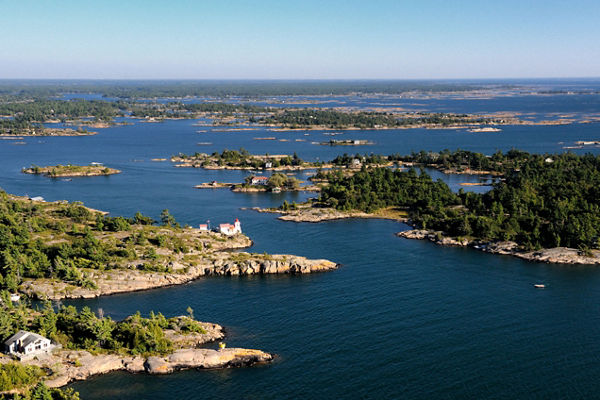
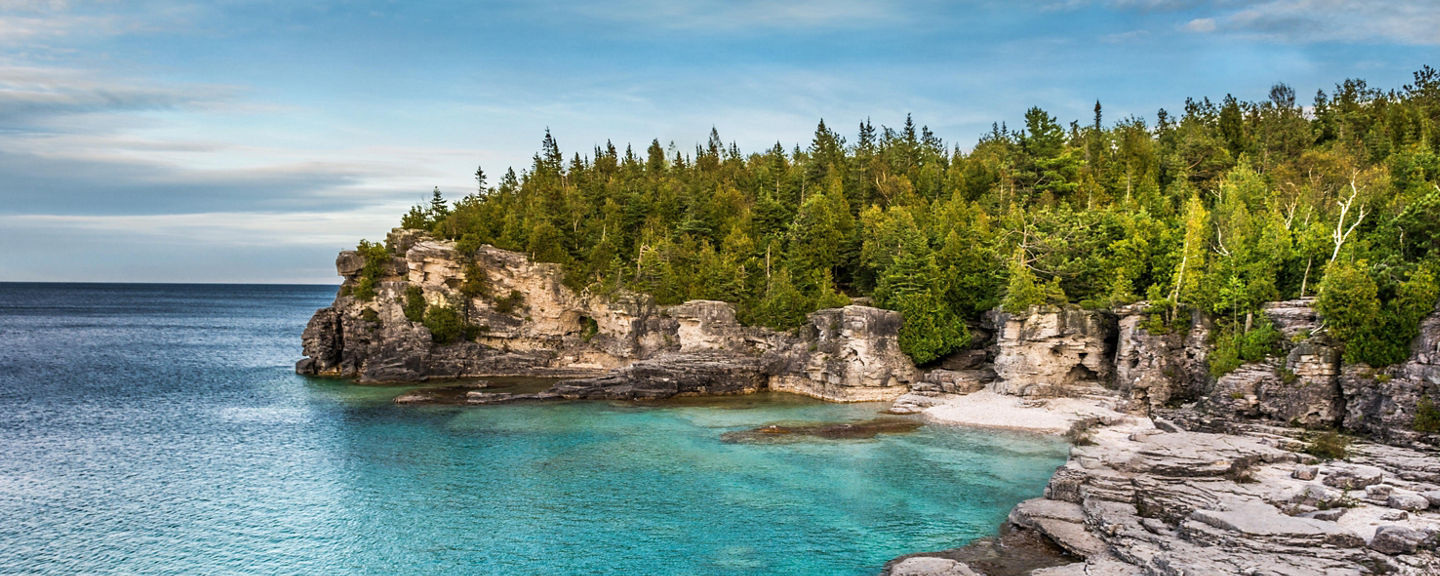
Scenic lake view with rocky shoreline

Explore the stunning Great Lakes

Experience the diverse landscapes and culture-rich cities of the Great Lakes. Read on to learn more about the unique geology of this remarkable region and discover the captivating excursions that await you on these picturesque bodies of water. Get acquainted with some of the area’s most popular dishes, uncover the inspiration behind Canada’s first national art movement and explore how this vast freshwater system developed more than 20,000 years ago.
Great Lakes

The Great Lakes comprise the largest freshwater ecosystem on the planet. An iconic part of the geological and cultural heritage of North America, the five lakes—Superior, Michigan, Huron, Erie and Ontario—contain nearly 5,518 cubic miles of water. They account for a full 20 percent of the world’s surface freshwater.

The lakes absorb a great deal of heat during warmer months, resulting in cooler summers and warmer winters than would otherwise occur. During the winter, the lakes’ eastern shores receive substantially higher precipitation, and large areas of the surface waters freeze.

The first inhabitants of the Great Lakes region were the Indigenous peoples, also known as Native Americans, Native Nations or, in Canada, First Nations. Many Indigenous groups living in the Great Lakes region were tribes or bands who spoke the Algonquin languages. The Huron were one such group and were the first people the French explorer Jacques Cartier came across when he arrived in 1534.

This magnificent region boasts stunning national parks and remarkable wildlife, such as river otters, red foxes and, during the spring and fall, many species of migratory birds. The peregrine falcon (Falco peregrinus) is one of the most notable birds in the region; during flight, it can reach diving speeds of more than 200 mph (321 kmh), making it the world’s fastest animal.

Peregrine falcon perched on tree stump
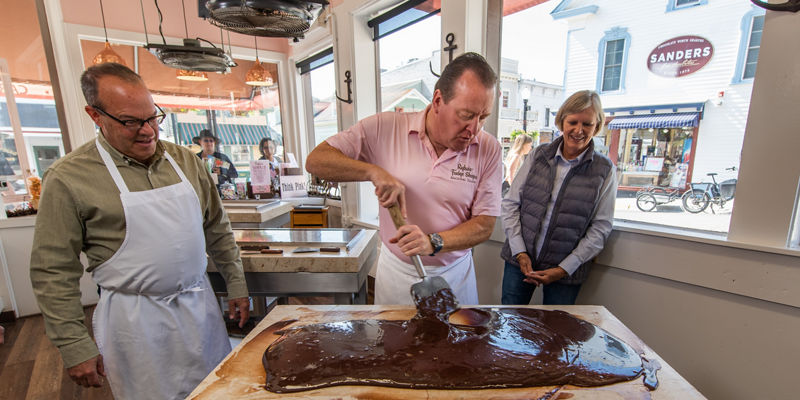
  • Chocolate-making demonstration in candy shop

    Cuisine—Popular dishes from the Great Lakes region

    During the 19th century, cities around the Great Lakes became important manufacturing centers, making them attractive to immigrants and jobseekers. As a result, the culinary traditions of this region reflect its rich history and the diverse cultures of its inhabitants. Here are some of the area’s signature foods:

    • Pasties
      A pasty (pronounced “pass-tea”) is an oven-baked, handheld pastry with a savory meat and vegetable filling. Fast, easy and portable, pasties were an ideal meal for workers. Despite their popularity in Michigan, pasties originated in medieval Europe and have a strong traditional link to the English county of Cornwall.
    • Mackinac Island Fudge
      Located in the Straits of Mackinac where Lakes Huron and Michigan meet, this charming island preserves many of its Victorian-era treasures, including this favorite 19th-century confection. Collectively, the island’s 13 fudge shops produce an estimated 9,920 lb (4,500 kg) of fudge each day during the summer season.
    • Deep-Fried Cheese Curds
      The Midwest—especially Wisconsin—became known for dairy farming in the 19th century, as German and Scandinavian families and settlers from New York brought their skills to the region. As their name suggests, cheese curds are made of curdled milk, a byproduct of the cheesemaking process. On their own, their texture is chewy, but when deep-fried in beer batter, they become gooey on the inside and crunchy on the outside.
    • Great Lakes Perch
      During the summer months, many menus around Lakes Ontario and Erie feature yellow perch, which are plentiful in shallow, warmer waters. Lightly pan-fried, this lean fish has a mild, sweet flavor and a beautifully flaky texture.
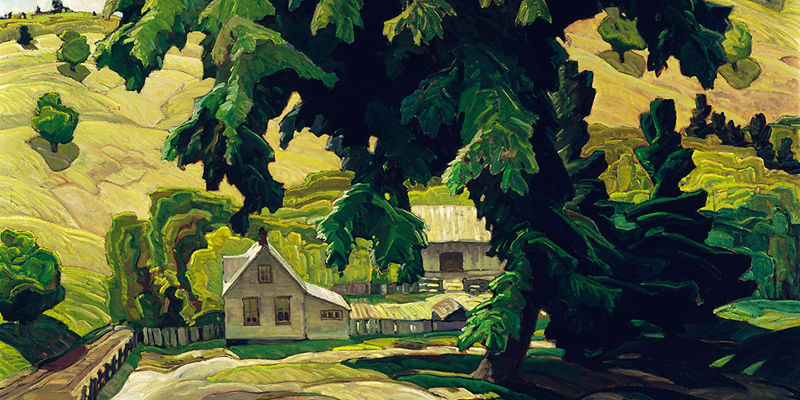
  • Idyllic countryside landscape with farmhouse

    Culture—The Group of Seven, Canada’s first national art movement

    During the second decade of the 20th century, a desire to create an artistic identity that was distinctively Canadian led a group of Toronto, Ontario-based painters to start Canada’s first national art movement—the Group of Seven.

    The group’s members—Franklin Carmichael, Lawren Harris, A.Y. Jackson, Frank Johnston, Arthur Lismer, J.E.H. MacDonald and Fredrick Varley—met while working as commercial artists at the influential Toronto advertising firm Grip Ltd. They bonded over a shared devotion to landscape painting and sought to be free from the constraints of the conservative, European-centric traditions that dominated painting at the time. The group formally adopted its name for its first exhibition, which was held in Toronto in 1920.

    Drawing inspiration from the post-impressionists and contemporary Scandinavian landscape painters, these painters focused on the ruggedly beautiful and unique character of the expansive Canadian outdoors. They often depicted landscape scenes rendered in impasto and composed of bright colors and bold forms.

    Their works created a vivid visual language to describe the vast scale of Canada’s landscape while invoking the burgeoning sense of the new country’s identity and independence. This can be seen in works such as Jackson’s energetic The Red Maple (1914), the looming clouds and impressionist hills of MacDonald’s October Shower Gleam (1922) or the simplified and idealized landscape of Harris’ Mount Robson (1922).

    Influential for more than a decade, the group went from receiving mixed reviews of their first exhibition to worldwide recognition as Canadian art pioneers. Having achieved their goal of establishing a distinctive Canadian artistic identity, the group officially disbanded in 1933. Its members went on to form the Canadian Group of Painters movement with other like-minded artists.

    Today, many of the masterpieces created by the Group of Seven and their contemporaries can be seen on display at Toronto’s Art Gallery of Ontario, one of the largest art museums in North America. Visitors can also take in some of the majestic Great Lakes scenery that inspired these artists, particularly in the stunning Muskoka region and near the historic town of Sault Sainte Marie.
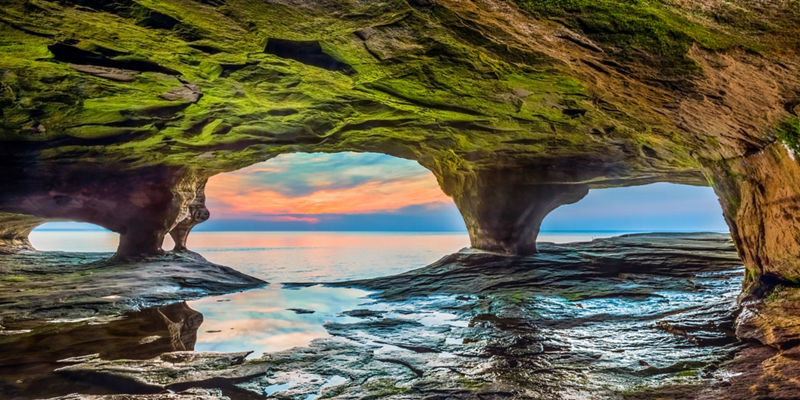
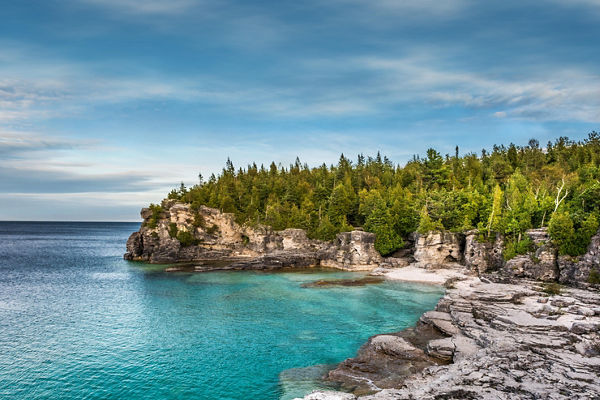
  • Scenic cave with sunset over water

    Nature—The formation of the Great Lakes

    Geologically, the Great Lakes are relatively young. They did not exist during preglacial times but were created after the Earth’s last period of large-scale glaciation during the Pleistocene Epoch, a time when the Laurentide Ice Sheet covered the northern United States and most of Canada in a mile-thick layer of ice.

    Approximately 20,000 years ago, rising global temperatures caused the ice sheet to start receding. The extreme weight and power of the retreating Wisconsin Ice Sheet that covered the Great Lakes region slowly carved out vast basins, causing melting ice to become trapped by the newly uncovered banks of sand, loose rock and boulders. Over time, water continued to accumulate, eventually forming large inland seas.

    The erosion of this massive ice sheet and the formation of the lakes was not a steady process. At one time, present-day Lakes Superior, Michigan and Huron were part of two vast inland lakes called Duluth and Algonquin. As the glaciers continued their northern journey, these two lakes created one gigantic lake.

    It was not until around 3,000 years ago that the Great Lakes reached their present-day size and form, an iconic feature that gives the state of Michigan its distinctive “mitten” shape.

Great Lakes Highlights

With more than 10,000 miles of coastline, the Great Lakes region offers much to discover. Captivating cities, charming islands and tranquil waterways await your exploration. Here are just some of the highlights you may experience on a Great Lakes voyage:

  • Explore the largest freshwater ecosystem on Earth
  • Watch for wildlife, from bald eagles to bears
  • Hike through stunning, pristine forests
  • Learn about Canada’s colonial past
  • Kayak in Georgian Bay—a UNESCO Biosphere Reserve
  • Visit the world-class Milwaukee Art Museum
  • Transit engineering marvels like the Soo Locks
  • Explore Sleeping Bear Dunes National Lakeshore

Destination Insight Videos

  • At home in Canada with Aaron Lawton (25:16)

    Enjoy another glimpse of “The Great White North” with Viking Expeditions Operations Manager Aaron Lawton, who leads us through some of his favorite places in Canada. Discover his British Colombia home in Squamish, then visit Vancouver and explore the Great Lakes, where Aaron offers us a peek into the best places to kayak and hike.

  • Discover the Great Lakes region with Jean Newman Glock (49:46)

    Join Viking Ambassador-at-Large Jean Newman Glock as she travels “Beyond the Brochure” and explores the hidden gems of Lake Michigan and Lake Huron. In Alpena, MI, Jean visits the Thunder Bay Marine Sanctuary where she uncovers the remarkable efforts being made to preserve the shipwrecks resting beneath the waves. Then, she journeys to Algoma, WI, on Lake Michigan to raise a glass to the picturesque von Stiehl Winery and sample local varietals. Finally, Jean arrives at Mackinac Island and heads to the iconic Grand Hotel to enjoy tea with a resident historian who sheds light on how the hotel survived Prohibition.

  • Discover Canada’s Georgian Bay with Jean Newman Glock (29:58)

    Join Viking Ambassador-at-Large Jean Newman Glock once again as she explores the scenic parks and vital waterways of the Great Lakes region. In this episode of Beyond the Brochure, Jean admires a remarkable birch bark canoe crafted by local First Nations people and learns about beekeeping In Killbear Provincial Park. Then, she journeys across the Georgian Bay and witnesses a NOAA balloon launch from the deck of one of our state-of-the-art expedition ships. She concludes her visit in the charming Okeechobee Lodge in Frazer Bay, where she enjoys stunning views of Baie Fine—the largest freshwater fjord in the world.

  • Explore America’s Great Lakes with guest lecturer Russell Lee (1:20:26)

    Enjoy another opportunity to expand your knowledge of the Great Lakes with award-winning writer and guest lecturer Russell Lee as he presents “The Story of Highway H2O: From the Great Lakes to the Atlantic Ocean.” Shared in his signature thought-provoking style, Russell’s lecture covers the history of the Great Lakes over the past 150 years, including the construction of the Erie Canal and St. Lawrence Seaway.

Great Lakes Travel FAQ

The Great Lakes consist of five freshwater lakes—Lake Superior, Lake Michigan, Lake Huron, Lake Erie and Lake Ontario—located in the northeastern region of North America, with the majority spanning the border between the United States and Canada. Lake Michigan is the only Great Lake located entirely within the United States. It borders four states—Michigan, Indiana, Illinois and Wisconsin.

The Great Lakes region offers a wide variety of outdoor and cultural activities across both Canada and the United States. Here is an overview by lake, listed from largest to smallest:
  • Lake Superior (Canada & US)
    The largest of the five Great Lakes, Lake Superior is known for its dramatic landscapes and outdoor adventures. Popular activities include hiking along the Apostle Islands in northern Wisconsin and visiting waterfalls like Kakabeka Falls in Ontario, Canada.
  • Lake Huron (Canada & US)
    The second-largest lake is home to Ontario’s Georgian Bay and the vast wilderness of Killarney Provincial Park, known for its lakes and Eastern mixed forest. Visitors can also explore historic shipwrecks at the Thunder Bay National Marine Sanctuary in Alpena, Michigan.
  • Lake Michigan (US only)
    The only Great Lake located entirely within the United States, Lake Michigan features destinations like the Door Peninsula in Algoma, Wisconsin, where visitors can enjoy boreal forests and sandy beaches.
  • Lake Erie (Canada & US)
    Known for its warmer waters and rich biodiversity, Lake Erie is a hotspot for birdwatching, especially at Point Pelee National Park in Ontario, Canada.
  • Lake Ontario (Canada & US)
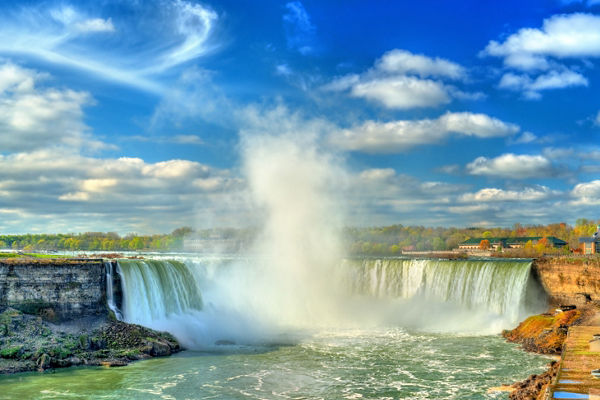
    The smallest of the Great Lakes, Lake Ontario is famous for the Welland Canal—one of Canada’s greatest engineering feats that connects it to Lake Erie. Lake Ontario is also a gateway to the world-famous Niagara Falls, located on the Niagara River.
Across all five lakes, visitors can enjoy kayaking, boating and fishing. Common fish species include salmon, trout and bass. In addition, the Great Lakes region is home to an estimated 115 lighthouses. These iconic structures symbolize strength and resilience, and many are open to the public. Visitors can enjoy guided tours, museum exhibits, and even overnight stays in some locations.

The Great Lakes—Superior, Michigan, Huron, Erie, and Ontario—are the largest group of freshwater lakes on Earth, holding nearly 20% of the world’s surface freshwater. They support a rich ecosystem and help regulate climate across the region, making them vital to both the environment and the communities that surround them. Visitors to the region can commonly see wildlife such as white-tailed deer, black bears, beavers, bald eagles, loons and monarch butterflies.

Culturally, the Great Lakes have shaped the identity of North America. They have long been home to Indigenous peoples whose traditions and stories are deeply tied to the lakes. Georgian Bay’s shores and waterways as an important trade route of the Anishinabek First Nations Peoples. Over time, the lakes became central to the growth of cities like Chicago, Toronto, and Detroit, serving as gateways for trade, immigration and innovation. Today, they continue to inspire art, music and storytelling across generations. For travelers, the Great Lakes offer more than just scenic beauty—they are a living museum of history and heritage. From historic lighthouses and shipwrecks to charming port towns and cultural landmarks, the region invites guests to explore its past and present in unforgettable ways.

The Great Lakes region’s rich history and cultural heritage is reflected in the names of its lakes, rivers and cities, stretching from the St. Lawrence Seaway to Lake Superior. These names highlight the centuries-long presence of Indigenous peoples and the spread of European influence since the 15th century.

The Iroquois tribes, who lived around Lakes Ontario, Huron and Erie, contributed names like Niagara (“the strait”), Ohio (“great river”) and Cuyahoga (“crooked water”). Canada comes from kanata (“village”), Ontario from kanadario (“sparkling water”) and Toronto from tkaronto (“place where trees stand in the water”).

The Ojibwa, in Ontario and Minnesota, gave us Michigan (“large lake”), Mackinac (“giant turtle”) and Mississauga (“great river mouth”). The Algonquin peoples of the Ottawa River Valley contributed Ottawa (“to trade”), Quebec (“narrow passage”), Wisconsin (“stream of red stone”) and Milwaukee (“good land”).

Other Indigenous names include Erie (“long tail”), Muskegon (“marshy river”) and Minnesota (“sky-tinted water”). European influence is seen in names like Montreal, Detroit and Lake Superior, preserving the legacy of early explorers and the establishment of New France in the Great Lakes region.

In the Great Lakes region, you can learn about several influential European explorers whose journeys helped shape the area’s early history. Jacques Cartier was one of the first Europeans to explore the Gulf of Saint Lawrence and the Saint Lawrence River in the 1530s, laying the foundation for French claims in North America. His voyages opened the gateway to the interior of the continent, eventually connecting to the Great Lakes through river systems. Samuel de Champlain, often called the “Father of New France,” expanded on Cartier’s routes in the early 1600s, mapping parts of the Great Lakes and establishing alliances with Indigenous nations. Étienne Brûlé, a young interpreter and explorer under Champlain’s guidance, was likely the first European to see Lakes Ontario, Erie, Huron and Superior. Their expeditions not only advanced geographic knowledge but also set the stage for trade, settlement and cultural exchange in the region.

All-Inclusive Itineraries—Great Lakes

Choose one of our enriching, all-inclusive voyages and discover the many benefits of exploring in Viking comfort.
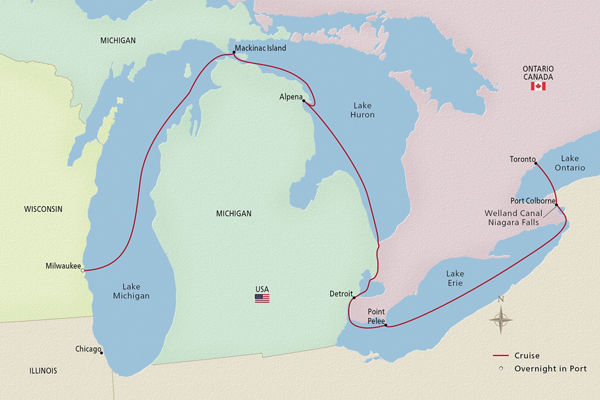
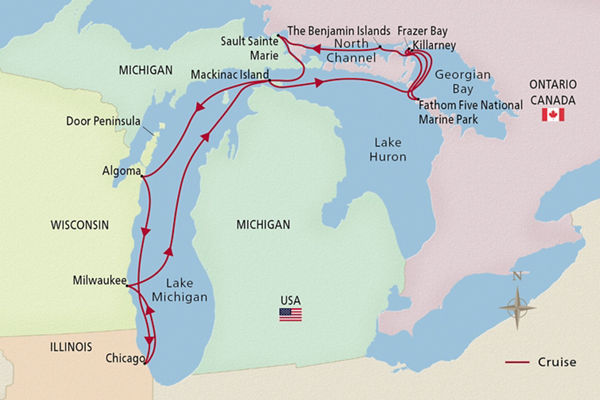
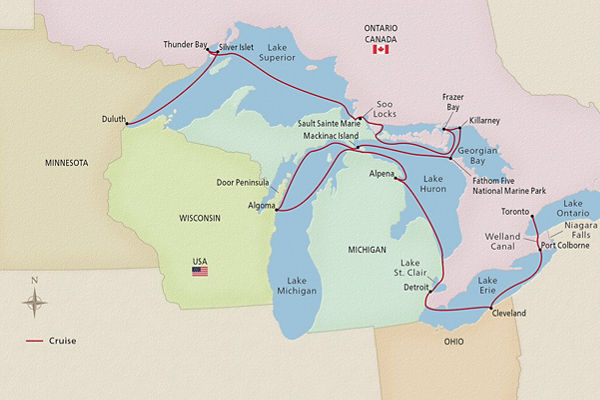
Hide map Show map

Niagara & the Great Lakes

Toronto, Ontario to Milwaukee, Wisconsin
SPECIAL OFFERS AVAILABLE ON 2026-2028 VOYAGES*

8 days
2 countries
AU$10,395 from
  • Learn More
  • Request a Quote
Hide map Show map

NEW! Great Lakes Treasures

Roundtrip Milwaukee, Wisconsin, United States
SPECIAL OFFERS AVAILABLE ON 2026-2028 VOYAGES*

10 days
2 countries
AU$12,295 from
  • Learn More
  • Request a Quote
Hide map Show map

Great Lakes Collection

Toronto, Ontario to Duluth, Minnesota
SPECIAL OFFERS AVAILABLE ON 2026-2028 VOYAGES*

15 days
12 tours
2 countries
AU$19,795 from
  • Learn More
  • Request a Quote
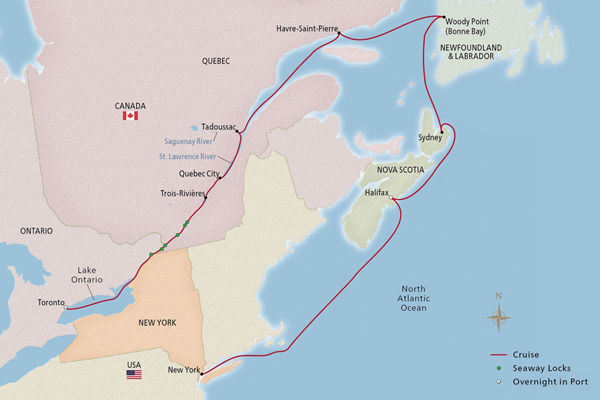
Hide map Show map

Canadian Discovery

New York City, New York to Toronto, Ontario
SPECIAL OFFERS AVAILABLE ON 2026-2028 VOYAGES*

13 days
2 countries
AU$12,295 from
  • Learn More
  • Request a Quote
View Cruises

Sign up to receive updates from Viking

Stay current with special offers, news and destination-focused content.

SIGN UP
Call a Viking Expert, or see your Travel Agent
Call a Viking Expert, or see your Travel Agent 138 747
138 747
TAP TO CALL
Viking Cruises Viking

Footnote

*Prices are per person, in Australian dollars and for Australian and New Zealand residents only. They are based on double occupancy, subject to availability and correct at time of publication. Prices include all advertised discounts. All offers are subject to availability and valid only for new bookings only on selected departures made between 02 December 2025 – 31 March 2026 at 6pm (AEDT) unless sold out prior. Viking reserves the right to correct errors or omissions and to change any and all fares, fees and surcharges at any time. View the Passenger Ticket Contract for full booking terms and conditions.
  • Company Information

    • Contact Us
    • Speak with a Viking Agent
    • Order a Brochure
    • Travel Advisors
    • FAQ: Expeditions
    • Media Center
    • About Us
    • Investor Relations
    • Careers
    • Site Map
    • Legal
    • Privacy Policy
    • Cookie Policy
  • Viking River Cruises

    • Europe
    • Asia
    • Egypt
    • Mississippi
  • Viking Ocean Cruises

    • Scandinavia
    • British Isles & Ireland
    • North America
    • Caribbean & Central America
    • South America
    • Mediterranean
    • Quiet Season Mediterranean
    • Asia
    • Australia & New Zealand
    • World Cruises
    • Grand Journeys
  • Viking Expeditions

    • Antarctica
    • The Arctic
    • Great Lakes
    • North America
    • South America
    • Grand Journeys
    • Longitudinal World Cruises

© Viking Cruises, 2025. All Rights Reserved.

Footnote

*Prices are per person, in Australian dollars and for Australian and New Zealand residents only. They are based on double occupancy, subject to availability and correct at time of publication. Prices include all advertised discounts. All offers are subject to availability and valid only for new bookings only on selected departures made between 02 December 2025 – 31 March 2026 at 6pm (AEDT) unless sold out prior. Viking reserves the right to correct errors or omissions and to change any and all fares, fees and surcharges at any time. View the Passenger Ticket Contract for full booking terms and conditions.

Company Information

  • Contact Us
  • Speak with a Viking Agent
  • Order a Brochure
  • Travel Advisors
  • FAQ: Expeditions
  • Media Center
  • About Us
  • Investor Relations
  • Careers
  • Site Map
  • Legal
  • Privacy Policy
  • Cookie Policy

Viking River Cruises

  • Europe
  • Asia
  • Egypt
  • Mississippi

Viking Ocean Cruises

  • Scandinavia
  • British Isles & Ireland
  • North America
  • Caribbean & Central America
  • South America
  • Mediterranean
  • Quiet Season Mediterranean
  • Asia
  • Australia & New Zealand
  • World Cruises
  • Grand Journeys

Viking Expeditions

  • Antarctica
  • The Arctic
  • Great Lakes
  • North America
  • South America
  • Grand Journeys
  • Longitudinal World Cruises

Call a Viking Expert, or see your Travel Agent Call a Viking Expert, or see your Travel Agent 138 747 138 747 Viking Cruises Viking
© Viking Cruises, 2025. All Rights Reserved.

EXPEDITION OFFERS TERMS & CONDITIONS

TERMS & CONDITIONS APPLICABLE FOR BOOKINGS MADE BETWEEN 02 DECEMBER 2025 – 31 MARCH 2026 AT 6PM (AEDT) ON ALL EXPEDITION SAILINGS (2025-2028)

  • Prices are per person, in Australian dollars and for Australian and New Zealand residents only. They are based on double occupancy and correct at time of printing. Prices include all advertised discounts, and all offers are subject to availability and may be withdrawn at any time. All offers are only valid for new bookings and only on selected departures made between 02 December 2025 – 31 March 2026 at 6pm (AEDT) unless sold out prior.
  • A partially refundable deposit of AU$1000 per person (in the form of a future cruise voucher less a AU$100 cancellation fee) is required to secure a confirmed reservation within 3 days of booking otherwise reservation may automatically cancel.
  • Once deposit payment has been made, standard cancellation penalties apply. When booking airfares through Viking (including when taking advantage of a special offer that includes air travel), standard airline cancellation fees also apply.
  • Displayed prices indicate the lowest available pricing across all available sailings from 2025 to 2028 and may have different offers applicable from those advertised for the promoted sailing years. Pricing for each itinerary can vary at short notice as availability changes and sailings close for the current season.
  • Complete terms and conditions may be found in the Passenger Ticket Contract.

Flexible Deposit Policy (01 April 2024 – 31 March 2026 at 6pm AEDT) Terms & Conditions.

  • Our flexible deposit policy applies to new reservations only made between 01 April 2024 – 31 March 2026 at 6pm AEDT and is combinable with all other Viking offers available.
  • Under our flexible deposit policy, qualified guests can cancel their booking before final payment due date and receive deposit back in the form of a future cruise voucher less a $100 per person cancellation fee.
  • Guests will have 24 months to select their new date and use their Future Cruise Voucher to make a new reservation on any river, ocean, or expedition cruise.
  • When booking airfares through Viking (including when taking advantage of a special offer that includes air travel), standard airline cancellation fees will also apply. In some cases, airfares will be non-refundable. In the event of cancellation, these fees will be deducted from the deposit paid, and therefore the future cruise voucher issued.
  • The future cruise voucher can be used on any new Viking cruise and will be applied at booking and must be redeemed by the expiration date prior to final payment.
  • The future cruise voucher has no cash value and will be applied as a ’Booking Discount’.
  • Once the voucher is redeemed, it cannot be re‐issued or used towards another cruise, and any unused balance of the voucher is lost and has no cash value.
  • Valid future cruise voucher is non-transferable.

APPLICABLE FOR BOOKINGS MADE BETWEEN 02 DECEMBER 2025 – 31 MARCH 2026 AT 6pm (AEDT) ON 2026, 2027 & 2028 EXPEDITION SAILINGS ONLY

Companion Fly Free Economy Flights up to the value of AU$2,500 when booking flights with Viking.

  • Companion Fly Free is economy flight(s) for one passenger up to the value of AU$2,500 to/from Australia/New Zealand.
  • If the flight cost exceeds AU$2,500 for that guest, the guest will cover the difference, to be paid at the time of flight booking.
  • If flights are cheaper than AU$2,500 for that guest, the unused portion of the air funds will be waived and cannot be transferred towards any other portion of the booking or any other person.
  • A guest can request the AU$2,500 to be used towards a flight upgrade from economy to a higher cabin class (booked through Viking) with AU$2,500 off the higher cabin airfare. The difference in flight cost must be covered by the guest and be paid at the time of flight booking.
  • Applicable if flights are booked through Viking and must be booked in conjunction with a selected 2026/2027/2028 Viking Expedition cruise.
  • Flights are Viking’s choice of airline for selected major gateways in AU/NZ: ADL/AKL/BNE/CBR/CHC/CNS/DRW/HBA/LST/MEL/OOL/PER/SYD/WLG.
  • Guests must return their air form to Viking within 14 business days of receiving request for flights, otherwise Viking reserve the right to remove the free air promo and apply the respective in lieu of flights discount.
  • Guest may not request to change to flights included promotion post campaign end date of 31 March 2026.
  • Viking will reach out to you or your travel advisor once flights are in the date range, at this point you may nominate your preferred departure/arrival dates.
  • Both guests must be on the same airline booking (PNR) and fly together in both directions, in the same cabin class.
  • Guests within the same booking must select the same offer.
  • Solo guests for Expedition can use up to AU$2,500 towards their flights. Any unused portion of the air funds will be waived and cannot be transferred towards any other portion of the booking or any other person or booking.
  • Flight offers and the deposit amount varies for Longitudinal World Cruises, Grand Journeys, From the Arctic to Antarctica and Arctic to Antarctic Explorer itineraries.
  • Companion Fly Free offer excludes Longitudinal World Cruises, From the Arctic to Antarctica and Arctic to Antarctic Explorer itineraries.
  • Valid on bookings made between 02 December 2025 – 31 March 2026 at 6pm (AEDT).
  • Please use code CFE25 to activate the Companion Fly Free offer when booking online or via the Contact Centre.
  • Guests can only redeem one offer per booking either Fly Free OR Business Class Air Credit OR Save and book Cruise Only.
  • If no code is selected when booking via online, the Companion Fly Free offer will be applied.

Business Class Air Credit up to the value of AU$2,500 when booking flights with Viking.

  • Guests receive a combined total of AU$2,500 Business Class Air Credit per booking towards their business class airfare with the difference to be covered by the guest and to be paid at the time of flight booking.
  • Any unused portion of the Business Class Air Credit will be waived and cannot be transferred towards any other portion of the booking or any other person.
  • Applicable if flights are booked through Viking and must be booked in conjunction with a selected 2026/2027/2028 Viking Expedition cruise.
  • Flights are Viking’s choice of airline for selected major gateways in AU/NZ: ADL/AKL/BNE/CBR/CHC/CNS/DRW/HBA/LST/MEL/OOL/PER/SYD/WLG.
  • Guest must return their air form to Viking within 14 business days of receiving request for flights, otherwise Viking reserve the right to remove the free air promo and apply the respective in lieu of flights discount.
  • Guest may not request to change to Business Class Air Credit promotion post campaign end date of 31 March 2026.
  • Viking will reach out to you or your travel advisor once flights are in the date range, at this point you may nominate your preferred departure/arrival dates.
  • Both guests must be on the same airline booking (PNR) and fly together in both directions, in the same cabin class.
  • Guests within the same booking must select the same offer.
  • Solo guests for Expedition cruises can use up to AU$2,500 per booking towards their Business Class flights. Any unused portion of the air funds will be waived and cannot be transferred towards any other portion of the booking or any other person or booking.
  • Valid on bookings made between 02 December 2025 - 31 March 2025 at 6pm (AEDT), excluding Longitudinal World Cruises, From the Arctic to Antarctica and Arctic to Antarctic Explorer itineraries.
  • Please use code CFB25 to activate the Business Class Air Credit offer when booking online or via the Contact Centre.
  • Guests can only redeem one offer per booking either Fly Free OR Business Class Air Credit OR Save and book Cruise Only.
  • If no code is selected when booking via online, the Companion Fly Free offer will be applied.

Save AU$2,500 and book flights independently.

  • Guest booking is eligible to get a total discount of AU$2,500 per booking off the cruise fare at the time of booking in lieu of the Companion Free Economy Class flights.
  • Solo guests will receive a dollar discount of AU$2,500 per booking off the cruise fare instead of the free companion flights.
  • Guests within the same booking must select the same offer.
  • Guests book their own flights independently of Viking.
  • Guest may not request to change to flights included promotion post campaign end date of 31 March 2026.
  • Valid on bookings made between 02 December 2025 – 31 March 2026 at 6pm (AEDT), excluding Longitudinal World Cruises, From the Arctic to Antarctica and Arctic to Antarctic Explorer itineraries.
  • Please use code CRX25 to activate the In Lieu of Flights offer when booking online or via the Contact Centre.
  • Guests can only redeem one offer per booking either Fly Free OR Business Class Air Credit OR Save and book Cruise Only.
  • If no code is selected when booking via online, the Companion Fly Free offer will be applied.

APPLICABLE FOR NEW BOOKINGS MADE BETWEEN 02 – 31 DECEMBER 2025 ON 2025 EXPEDITION SAILINGS.

CRUISE ONLY OFFER – Save up to 30% on selected 2025 Viking Expedition voyages.

  • Applies to any new booking made between 02 - 31 December 2025 on a 2025 Viking Expedition voyage.